Learn Spanish, right here in Camposol
Local classes, the Spanish alphabet, pronunciation guides and the Spanish radiotelefonía phonetic alphabet · all the essentials for finding your feet in Spain.
Jon Hibberd
Our Spanish "tips and tricks" are provided by Jon Hibberd. Jon teaches Spanish classes at all levels, right here in Camposol.

Jon Hibberd
Spanish Teacher · CamposolJon, originally from Swindon in Wiltshire, has lived and worked in Spain for almost 20 years. When Jon first arrived in Spain, he worked for El Pozo, the meat factory in Alhama De Murcia. After fulfilling a 12-month contract with them it was sadly not renewed, but what a way to perfect your Spanish.
Jon "fell" into teaching and taught privately, in schools, businesses and opened an English academy which he ran successfully for 10 years. It was during this period that Jon had the opportunity and experience to teach Spanish instead. Classes were primarily in Camposol.
Jon always tried to make the classes fun and tailored to the actual class. He loves what he does and he hopes that comes across to his loyal students, some of whom have been with him for years.
27 letters, one new sound
The Spanish alphabet has all 26 English letters plus Ñ. Here's the name of each letter and a simple pronunciation guide.
like a in father
like beh
like the in think (Spain) before e/i; otherwise k
like deh
like e in met
eh-feh
heh before e/i (Spain); hard g otherwise
ah-cheh (letter is silent in words)
like ee in see
strong throaty hota
kah
eh-leh
eh-meh
eh-neh
en-yeh (like ny in canyon)
like o in told (shorter)
peh
koo
rolled r
eh-seh
teh
oo in food
oo-beh
oo-beh doh-bleh
eh-kees
yeh
theh-ta (Spain) / seh-ta (Latin America)
English vs Spanish phonetics
Need to spell out your name or address over the phone? Use the official Spanish Radiotelefonía alongside the NATO alphabet you may already know.
| Letter | English (NATO) | Spanish (Radiotelefonía) |
|---|---|---|
| A | Alfa | Antonio |
| B | Bravo | Barcelona |
| C | Charlie | Carmen |
| D | Delta | Dinamarca |
| E | Echo | España |
| F | Foxtrot | Francia |
| G | Golf | Granada |
| H | Hotel | Huelva |
| I | India | Italia |
| J | Juliett | José |
| K | Kilo | Kilo |
| L | Lima | Lisboa |
| M | Mike | Madrid |
| N | November | Navarra |
| O | Oscar | Oviedo |
| P | Papa | París |
| Q | Quebec | Quito |
| R | Romeo | Roma |
| S | Sierra | Sevilla |
| T | Tango | Toledo |
| U | Uniform | Uruguay |
| V | Victor | Valencia |
| W | Whiskey | Washington |
| X | X-ray | Xilófono |
| Y | Yankee | Yolanda |
| Z | Zulu | Zaragoza |
Spanish Conversation Classes
There are also Spanish Conversation classes with the lovely Josefina Sánchez Montalbán. If it's just a laid-back conversation in Spanish you want without all that horrible grammar stuff, then don't hesitate to contact her.
The biggest errors
"Learning Spanish isn't easy. Here are a few hurdles that English speakers face if they want to master the Spanish language."
1. The pronunciation
The H is silent, so hola is said "ola". The J is tricky too, more like the Scottish "loch". And the double R sounds like a little motorbike! Spanish also has the Ñ, which sounds like the "n" in onion. "Year" is año, but get the ñ wrong and it turns into a much ruder word.
2. It is all back to front
"My sister's house" becomes "the house of my sister", la casa de mi hermana. And "I love you" is te quiero, which literally reads "you I love".
3. Masculine and feminine
Every noun is either masculine (el): el pan, el restaurante, el hombre; or feminine (la): la tienda, la casa, la mujer. Luckily, if you slip up here you will still be understood.
4. So many verb forms
There are six ways to use each verb: (I) hablo, (you) hablas, (he/she) habla, (we) hablamos, (you all) habláis, (they) hablan. The good news is there is a pattern.
5. One word, many meanings
Some words mean more than one thing, or different words mean the same thing. "Hot" can be calor or caliente. "Take" could be coger, tomar or tardar!
6. Ser and estar
Spanish has two words for "to be". For "I am" you choose between soy and estoy. Usually it is easy, but take care: to say you are hot, "estoy caliente" actually means you are feeling rather amorous! What you want is ¡tengo calor!
All of the above is covered in Jon's Spanish classes, and plenty more. Learning Spanish as a hobby should be fun and enjoyable, so do not worry about making mistakes. The Spanish will always commend you for having the courage to try.
Get in touch with Jon
Spanish classes at all levels, taught right here in Camposol. Fun, tailored to the class, and loved by his loyal students.
Beginner Spanish: a month of little tasks
Jon's favourite starter sheet for people beginning Spanish classes. It gives you a small task for each day over a month, noting down the basics such as numbers, colours and the days of the week. Of course you can use Google Translate to help you along.

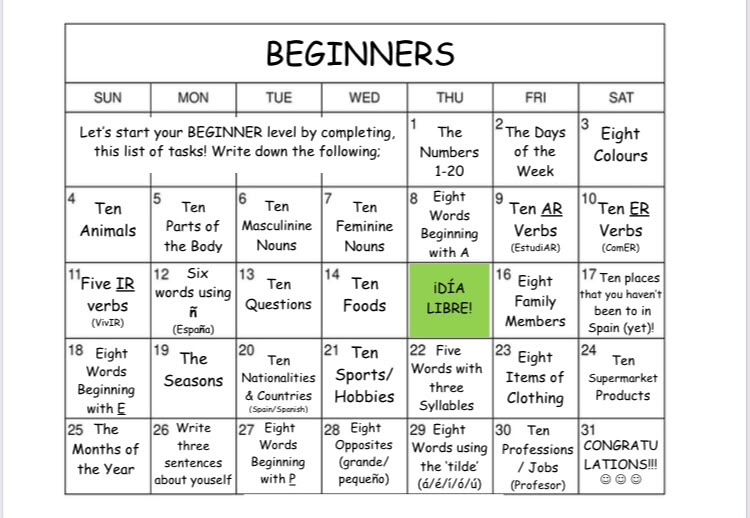
Tap the sheet to open it full size.
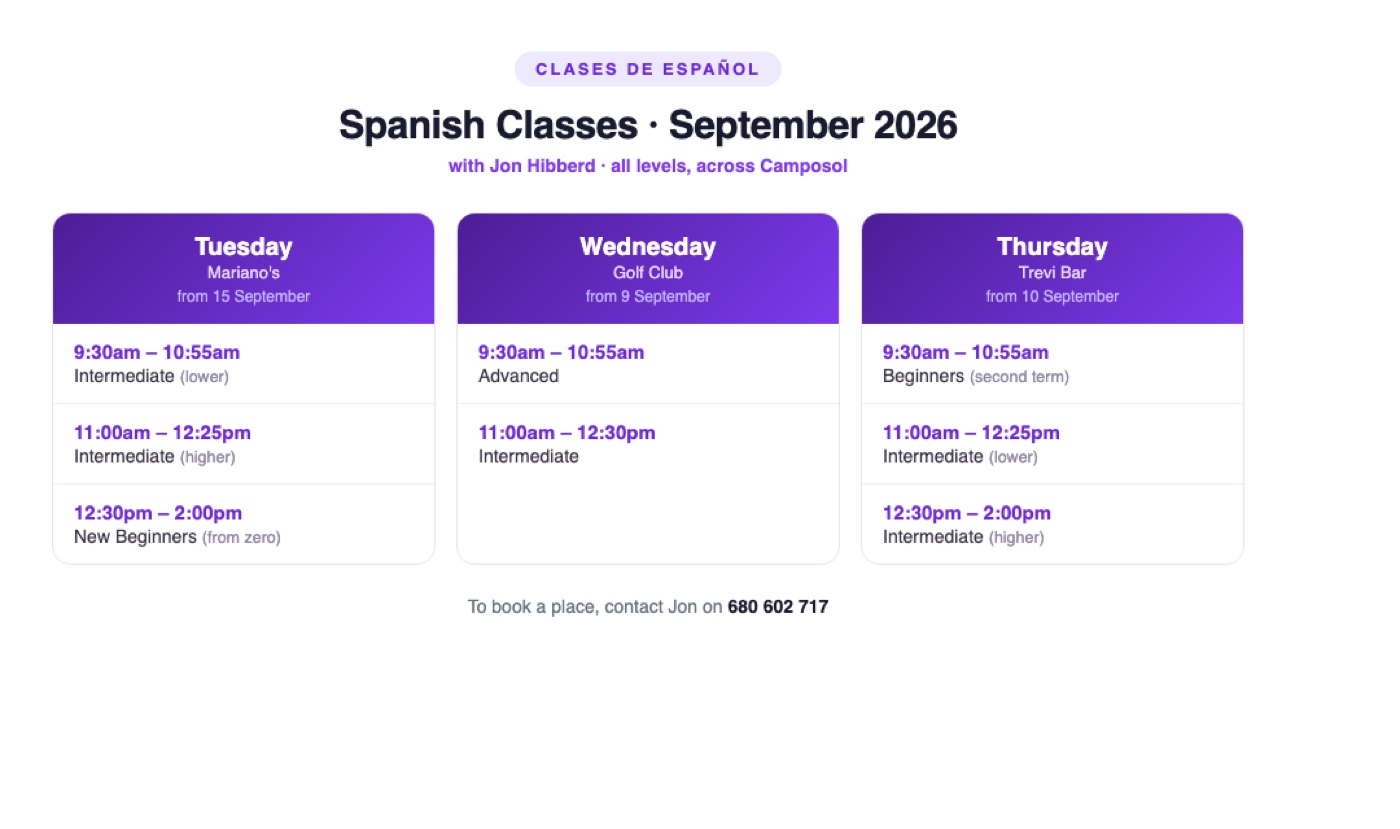
Spanish Classes September 2026
Jon Hibberd runs Spanish classes at all levels across Camposol. Classes are now finished for the summer and return in September. Here is the new September timetable.